
There’s a moment that happens to almost every first-time visitor to Corolla. You’re driving north on NC-12, the Atlantic on your right, the Currituck Sound glinting on your left, and then, without warning, the pavement simply stops. One second you’re on a road, the next the road is gone, replaced by open sand stretching into the distance as far as you can see.
That’s when it hits you: this place is different.
Corolla sits at the northern tip of North Carolina’s Outer Banks, about 30 miles north of Kitty Hawk, and it operates by its own rules. There are no traffic lights. No chain restaurants on every corner. No hotel row. What it does have: wild Colonial Spanish mustangs roaming the dunes, miles of remote 4WD beach, a stunning 19th-century lighthouse, and some of the most spectacular scenery on the entire East Coast, is more than enough.
Here’s everything you need to know before you go.
The Wild Horses: The Whole Reason You’re Going
Let’s be honest. Most people come to Corolla because of the horses, and the horses absolutely deliver.
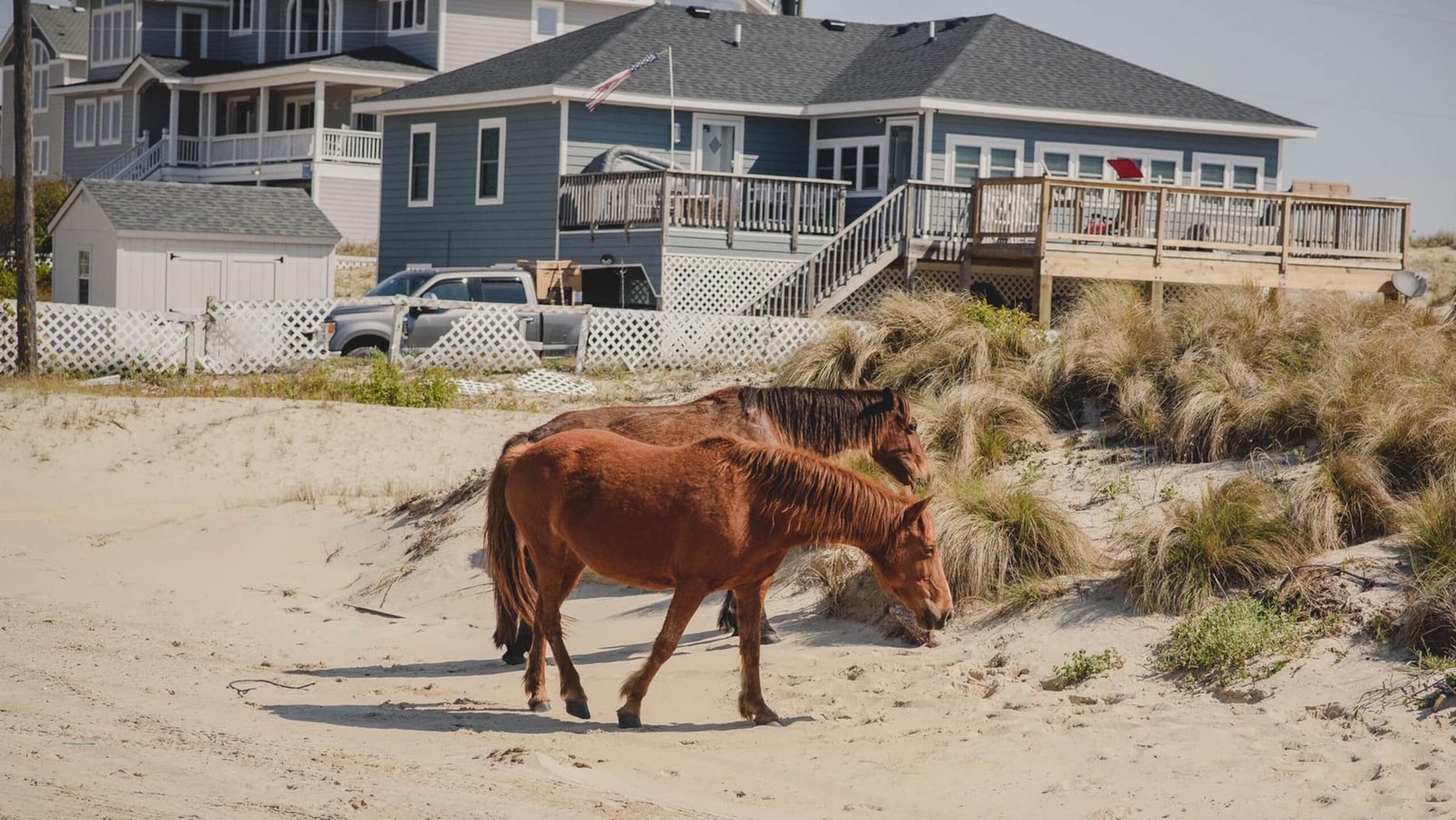
These are Colonial Spanish Mustangs, descendants of horses believed to have arrived on the Outer Banks with Spanish explorers roughly 500 years ago. Whether they swam ashore from a shipwreck or were left behind by settlers fleeing conflict with Native Americans (both stories are told), the result is the same: a herd of wild horses that has survived on these barrier islands for centuries, adapting to salt air, coastal storms, and whatever the dunes provide. That history makes seeing them feel genuinely extraordinary.
Here’s the crucial thing to understand: the horses live north of where the pavement ends. By 1997, the entire herd was relocated to the remote beach area of Carova, north of Corolla, to keep them safe from traffic and development. Today they roam about 7,500 acres of coastal land between the northern Corolla border and the Virginia state line. There are currently around 100 horses in the herd, living in small family groups of three to six.
Getting to them requires either a 4WD vehicle or a guided tour but more on both of those in a moment. But first, the rules, because they matter:
- Stay at least 50 feet from the horses at all times. This is law, not suggestion. Currituck County enforces it, and fines are real.
- Do not feed the horses. Ever. It is illegal and genuinely dangerous to them. The horses’ digestive systems are adapted to their coastal diet, and human food can be seriously harmful.
- Stay in your vehicle if you encounter them on the beach or road. They will sometimes walk right up to or across your path. Let them pass.
These aren’t zoo animals. They’re wild, unpredictable, and protected. Respecting that is what keeps them here.
Getting to the Horses: Tours vs. DIY 4WD
You have two options for reaching the wild horse area, and both are legitimate.
Option 1: Book a Guided Tour
If you don’t have a 4WD vehicle, this is your answer and honestly, even if you do, a guided tour can be a wonderful experience. Several reputable companies in Corolla run two-hour open-air safari-style truck tours that take you north of the pavement, through the Carova neighborhoods and along the beach, with knowledgeable guides sharing the history of the horses and the area. Tours typically cover about 25 miles of off-road terrain. Reservations are strongly recommended, especially in peak season (June and July). Multiple operators run tours, so look around, read reviews, and book in advance.
Option 2: Drive Yourself
If you have a true 4WD vehicle (not all-wheel drive but an actual 4WD), you can access the beach yourself. Here’s what you need to know:
First, deflate your tires before hitting the sand and aim for around 15–20 psi. Properly aired-down tires give you the flotation you need to stay on top of soft sand rather than sinking into it. Air stations are available at Historic Corolla Park to reinflate when you return.
Second, you need a beach parking permit if you’re not staying in a rental home on the 4WD beach. Seasonal permits are available in Corolla.
Third, don’t park in the first mile and a half north of the 4WD access point, there are signs, and the rules are clear. The beach speed limit is 35 mph (drop to 15 mph within 300 feet of any person). Watch for stumps partially buried in the sand, especially at low tide because they’re a real hazard.
A heads-up: you may drive quite a way north before spotting any horses. They have 7,500 acres to roam, and some days they’re deep in the maritime forest neighborhoods rather than on the beachfront. Patience and a willingness to drive around the Carova community (there are unpaved roads there) will improve your odds significantly.
Wondering if you really need a Jeep rental to spot the herd? Not necessarily. We broke down every option, including the totally free spot near the village, in our guide to seeing Corolla’s wild horses without a tour or 4WD. It’s worth a read before you book anything.
The Currituck Beach Lighthouse: Climb It
Once you’ve had your horse encounter, make time for the Currituck Beach Lighthouse. It’s one of the most distinctive landmarks on the entire Outer Banks, and it earns every superlative thrown at it.
Built in 1875, the lighthouse was constructed specifically to fill a 40-mile dark gap along the coast between Cape Henry (Virginia) and Bodie Island, a stretch where ships were regularly getting lost. The solution the lighthouse board landed on was both practical and visually striking: leave the brick unpainted, so the red tower would stand out as a daymark distinguishable from other OBX lighthouses. That unpainted brick exterior is still there today, weathered and beautiful.
The lighthouse stands 162 feet tall and its First Order Fresnel lens, the largest of its type, still flashes every 20 seconds after dark, visible for 18 nautical miles out to sea. It’s one of only a few lighthouses in America still operating with its original first-order lens.
Climbing it: The tower is open daily from 9 AM to 5 PM, generally from mid-March through late November (weather permitting). The climb is 220 steps on a spiraling iron staircase, with nine landings where you can pause to catch your breath and take in exhibits about the lighthouse’s history. Admission to climb runs about $10 for adults; grounds admission and parking are free. Climbers must be at least 4 years old.
The view from the top the Atlantic on one side, the Currituck Sound on the other, the village below is worth every one of those 220 steps. The Whalehead Club (a gorgeous 1920s Art Nouveau hunting lodge next door, also worth a visit) is visible right from the top. Plan at least an hour to climb, explore the exhibits, and soak it in.
The Practical Stuff: What to Know Before You Arrive
Getting there. Corolla is accessible only via NC-12 heading north from the Outer Banks. There is no bridge directly to Corolla. You reach it by driving through the rest of the OBX. If you’re coming from inland NC, your GPS will likely route you through Currituck on the mainland and across the Wright Memorial Bridge into the OBX, then north on 12.
Where to stay. Corolla is primarily a vacation rental community as large beach houses are the norm here, often booked by families or groups. There are very few traditional hotels. Rental homes in the 4WD beach area (Carova) come with two county beach parking passes included, which is a nice perk if you want vehicle beach access. Book early; summer weeks fill up months in advance.
Restaurants and groceries. Corolla has a modest but decent selection of shops and restaurants clustered near the Timbuck II shopping village. There’s a Food Lion for groceries. Once you head north of the pavement, there is nothing, no food, no fuel, no services. Stock up before you go.
When to visit. Summer is peak season and absolutely packed and has great energy, fully staffed services, but can be crowded and expensive. The shoulder seasons (late April through May, and September through October) offer slightly cooler temps, fewer crowds, and often just as much beauty. Fall in particular can be spectacular on the northern Outer Banks, with warm water well into October and dramatically open beaches.
Corolla isn’t for everyone. If you want resort pools and neon boardwalks, drive further south. But if you want wild horses walking past your rental house at sunrise, open beach stretching endlessly in both directions, and a lighthouse that’s been standing watch since 1875, Corolla will get under your skin in the best possible way.
Where the road ends, the real adventure begins.
For more Carolina vacation area guides and Carolina coastal travel inspiration, keep exploring explorecarolinabeaches.com
Corolla’s wild mustangs are one of the biggest reasons travelers choose the Outer Banks over more developed beach towns. If you’re weighing OBX against Myrtle Beach, this comparison lays out the key differences.
FAQ
Is Corolla good for families with young children?
Yes. Corolla is one of the most family-friendly destinations in the Outer Banks, offering wide beaches, spacious vacation homes, outdoor activities, and a quieter atmosphere than many other beach towns. Families especially appreciate the uncrowded beaches and natural surroundings.
When is the best time to visit Corolla?
May through June and September through October offer warm weather, comfortable ocean temperatures, and fewer crowds. Summer is the most popular season for beach vacations and outdoor recreation.
Are dogs allowed on Corolla beaches?
Yes. Dogs are generally welcome on Corolla’s beaches year-round, though owners must follow local leash and pet-control regulations.
Is parking free at Corolla?
Yes. Many public beach access points offer free parking, though availability can be limited during peak summer weekends. Four-wheel-drive beach areas may have separate access requirements.
How far is Corolla from Charlotte, Raleigh, Cleveland, and Nashville?
Charlotte: about 420 miles (7–8 hours)
Raleigh: about 240 miles (4–5 hours)
Cleveland, Ohio: about 660 miles (10–11 hours)
Nashville, Tennessee: about 815 miles (12–13 hours)
What is Corolla known for?
Corolla is famous for its wild Spanish mustangs, expansive beaches, luxury vacation homes, and the four-wheel-drive beaches north of town. Visitors also enjoy the historic Currituck Beach Lighthouse and the area’s unique combination of natural beauty and Outer Banks history.
What are the best restaurants near Corolla?
Popular local favorites include North Banks Restaurant & Raw Bar for seafood and steaks, Oceanfront Grille for waterfront dining, Uncle Ike’s Sandbar & Grill for casual coastal fare, and Mike Dianna’s Grill Room for fresh seafood and local favorites.
Planning a Carolina beach trip? Use our Beach Finder Quiz to get a personalized recommendation, or compare any two beaches side by side with the Carolina Beach Comparison Tool.
📱 Download our free Carolina Beaches app — Get it here