

Every beach town on this coast loves your dog. Just not on their exact terms.
One town lets your Lab run wild at sunrise. The next fines you $250 for the same move at noon. Nobody bundles this information anywhere useful; it’s scattered across forty municipal PDFs, half of them written for lifeguards, not vacationers. So let’s fix that.
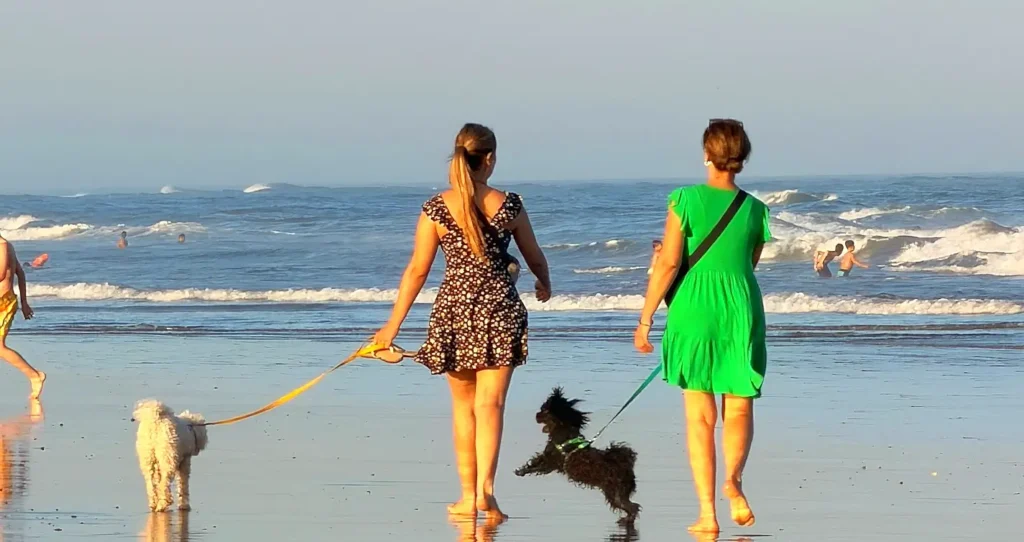
Can You Still Take Dogs to the Beach? (Mostly, Yes, With Timing)
Short answer: absolutely, but the clock matters more than the calendar in most towns. Nearly every beach community between the Outer Banks and the Lowcountry allows dogs. Almost none allow them unrestricted during peak summer hours.
The pattern repeats up and down the coast. Off-season, roughly October through March, dogs get the run of the sand, often leash-free. Summer flips the script. Towns push dogs to early mornings and evenings, banning them entirely from mid-morning through late afternoon.
Locals’ take:
Nobody enforces leash laws at 7 a.m. in January. Locals know this. It’s the unspoken loophole every dog owner on this coast quietly uses.
Outer Banks: The Most Forgiving Stretch
Duck earns its reputation as arguably the most dog-friendly of all Outer Banks towns, letting leashed-optional dogs roam year-round as long as owners keep control. Corolla follows close behind, welcoming dogs year-round, leashed, with no specific leash length required.
Kill Devil Hills and Southern Shores run tighter ships. Kill Devil Hills bans dogs from public beaches from May 15 to September 15 between 9 a.m. and 6 p.m., service animals excepted. Nags Head stays relaxed nearly all year, requiring only a leash and prompt waste cleanup, with no leash length requirement.
Insider detail:
Cape Hatteras National Seashore runs its own rules separate from the towns. Dogs need a 6-foot leash at all times, and resource closures are off-limits entirely. Blowing past that isn’t just rude; it disturbs nesting shorebirds the Park Service actively protects.
Wilmington Area: Feast or Famine
Wrightsville Beach draws a hard line. Dogs are banned from the beach strand entirely between April 1 and Sept. 30, while leashed dogs get the whole beach any hour from Oct. 1 through March 31. There’s real momentum behind loosening that ban. The town issued 110 dog-related enforcement actions in 2025 alone, mostly for off-leash dogs or restricted-hours violations, and the board has debated changes. Don’t count on it changing before your trip, though.
Carolina Beach solves the problem nearby. Freeman Park allows leashed dogs April through September and lets them run free under voice command from October through March. Topsail Beach does the same trick, going leash-free off-season while requiring leashes from May 15th through September.
What most visitors don’t know:
Caswell Beach, way down near Oak Island, may be the single most consistent dog beach in the state. Dogs can go there any time of year on a leash, not just during off-peak times. No summer ban, no odd hourly windows. Just a leash and a beach.
Grand Strand: Myrtle Beach and North Myrtle Beach
Myrtle Beach proper bans dogs from the sand from 10:00 a.m. to 5:00 p.m., May 1 through Labor Day. Outside that window, and from Labor Day through April, dogs roam freely on a leash no longer than seven feet.
North Myrtle Beach tightens the summer window further, keeping dogs off the beach between 10:00 a.m. and 4:00 p.m. during peak season, with the same seven-foot leash cap enforced year-round. Neither town allows off-leash beach time, ever, a real contrast to the Outer Banks.
Locals’ take:
If your dog needs to run, skip the sand entirely and hit Barc Parc South at Market Common. It’s a fenced 14-acre space with a pond, split into large-dog and small-dog sections, and it’s the rare spot within the Myrtle Beach city limits with no leash law.

Charleston and the Lowcountry: Complicated, But Worth Learning
Folly Beach bans dogs midday in summer, from 10 a.m. to 6 pm from May 1st to Sept. 30th, then opens the whole beach to leashed dogs the rest of the year. One rule holds constant everywhere on Folly: never bring a dog onto the fishing pier.
Isle of Palms plays a genuinely fun shell game with off-leash windows. From April through mid-September, dogs can go off-leash from 5 a.m. until 9 a.m., then be leashed the rest of the day. Flip to fall and winter, and off-leash hours stretch from 4 p.m. until 10 a.m., a huge window for an evening walk on the sand.
What most visitors don’t know:
Seabrook Island splits its beach into zones. One stretch bans dogs completely, leashed or not, while another allows dogs but requires a leash at all times, no exceptions. Read the posted signage before you assume the whole beach follows one rule.
The 5 Best Dog-Friendly Beaches on the Carolina Coast
- Duck, NC: Off-leash play year-round under voice control. The gold standard on the Outer Banks.
- Caswell Beach, NC: Leashed dogs welcome every day, all year, no summer ban whatsoever.
- Isle of Palms, SC: Generous off-leash windows that shift with the seasons, right outside Charleston.
- Corolla, NC: Year-round beach access with no fussy leash-length rules to memorize.
- Freeman Park, Carolina Beach, NC: Off-leash freedom every winter, plus a genuinely wild, undeveloped feel.

What to Bring for a Dog at the Beach
Pack more than you think. A collapsible water bowl and fresh water top the list, ocean water upsets stomachs fast. Bring a towel just for the car ride home, and a second leash as backup; salt water corrodes clips faster than you’d expect.
Booties help on hot pavement and boardwalks, even if your dog hates wearing them. A pet-safe sunscreen matters for thin-coated breeds and pink noses. Finally, always carry your own waste bags, most towns provide stations, but not every access point has one stocked.
How Beaches Affect a Dog’s Paws
Sand looks soft. It isn’t always kind. Midday sand on the Carolina coast regularly hits 120°F in July, hot enough to blister paw pads within minutes. Salt water dries skin between the toes, and shell fragments cause small cuts that go unnoticed until your dog starts limping later.
Test the sand with your own bare hand first. If you can’t hold your palm on it for five seconds, it’s too hot for paws. Rinse feet with fresh water after every visit to wash away salt and sand grit.
The Real Risks of Bringing a Dog to the Beach
Heat exhaustion tops the list, especially for flat-faced breeds like bulldogs and pugs. Saltwater ingestion causes a real condition called saltwater poisoning, leading to vomiting and, in bad cases, seizures. Rip currents don’t discriminate between species; a dog chasing a ball into rough surf can get swept out just as easily as a person.
Jellyfish stings, sharp shell fragments, and unfamiliar dogs off-leash round out the list. None of this means to stay home. It means watch closely, bring water, and know the exit plan before things go sideways.
FAQ: Carolina Coast Pet Policies
Are dogs allowed on the beach in summer? Usually, yes, but only during early morning and evening hours in most towns. Midday bans are common from Memorial Day through Labor Day.
Do leash laws change in the off-season? Frequently. Many towns drop leash requirements entirely from October through March, provided the dog stays under voice control.
What’s the fine for breaking beach pet rules? It varies widely by town, from around $100 up to over $1,000 in places like Folly Beach for repeated ordinance violations.
Can service dogs go on the beach anytime? Yes. Every town on this coast exempts service animals from seasonal and hourly beach restrictions.
Do I need a rabies tag for my dog at the beach? Some towns, including several on the Outer Banks, require a current rabies tag on the collar at all times, even during a beach walk.
Rules shift year to year, and enforcement varies even within the same town depending on the beach access point. Always check the current municipal ordinance before your trip; this guide reflects verified 2026 policies, but coastal towns do update these rules seasonally.
The Carolina coast doesn’t just tolerate dogs. It builds entire mornings around them. Find your town, learn the clock, and let the sand do the rest.
For more travel guides, beach recommendations, and coastal travel inspiration, keep exploring explorecarolinabeaches.com
Planning a Carolina beach trip? Use our Beach Finder Quiz to get a personalized recommendation, or compare any two beaches side by side with the Carolina Beach Comparison Tool.
📱 Download our free Carolina Beaches app — Get it here