
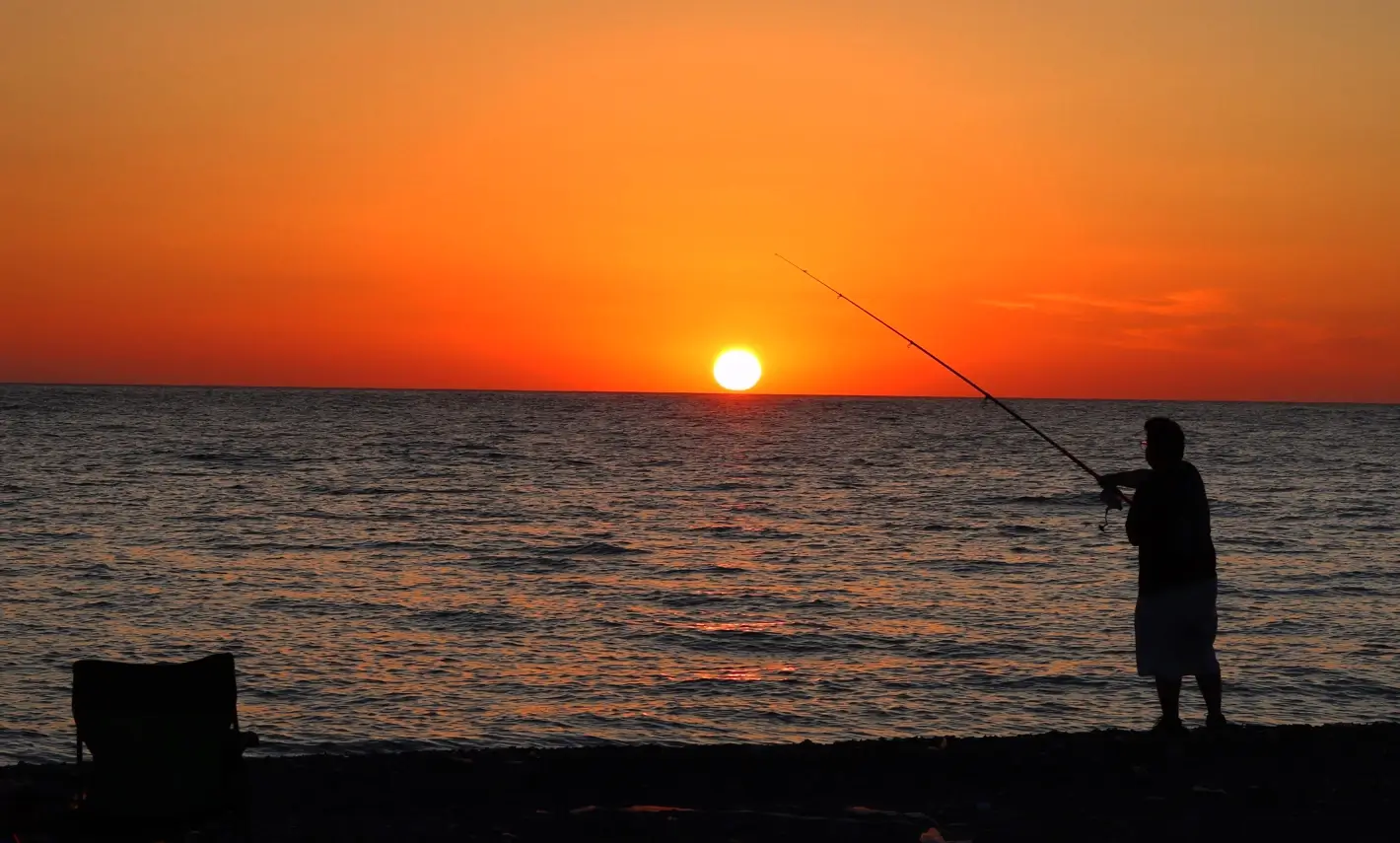
From the legendary surf at Cape Point to the tidal creeks of the Lowcountry, the Carolinas don’t just offer good fishing, they offer an identity.
The Carolina coast has always attracted two kinds of people: those who come to sit on the beach, and those who come to catch something from it. Often, they’re the same person. That’s the thing about Fishing the Carolina Coast, it doesn’t ask you to choose between adventure and relaxation. It just hands you a rod and dares you to pay attention.
From the Outer Banks of North Carolina, where two of the Atlantic’s major ocean currents collide in a churning, fish-rich stew, down to South Carolina’s Lowcountry, where redfish hunt through spartina grass at high tide, the Carolinas deliver one of the most diverse saltwater fishing experiences on the entire East Coast. You don’t need a boat. You don’t need a charter. Sometimes, you just need a bucket of shrimp and a folding chair.
Here’s everything you actually need to know before you wet a line.
Can You Fish from the Beach in the Carolinas?
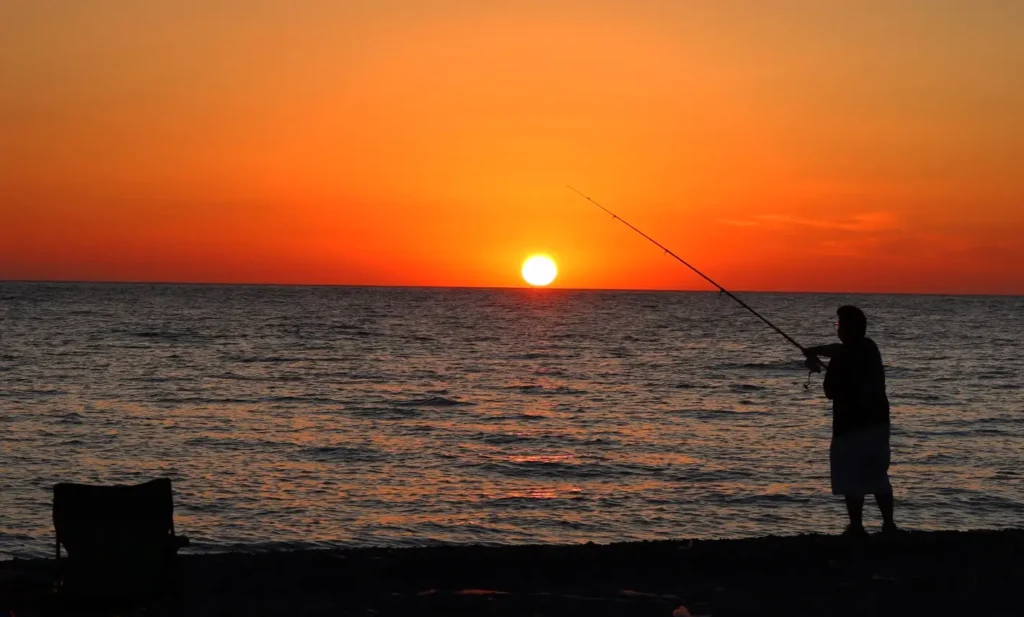
Not only can you, it’s practically a coastal tradition. Surf fishing is one of the most democratic outdoor sports on the Carolina coast. No boat, skipper, or reservation. Just you, the Atlantic, and whatever decides to investigate your bait.
All along the North Carolina shoreline, from the remote beaches of Corolla in the north to the Brunswick Islands in the south, anglers wade into the surf and cast. South Carolina’s Grand Strand, Edisto Beach, and Hunting Island all offer solid surf access for anyone willing to show up at the right tide. The beaches are largely public, the fish are real, and the learning curve is gentler than most people expect.
What most visitors don’t realize is that the surf zone itself, that churning, turbulent strip where waves break, is actually prime feeding territory. Waves disturb the sandy bottom and flush out sand fleas, crabs, and baitfish. Predatory species like pompano, whiting (sea mullet), red drum, and flounder follow the buffet.
If fall surf fishing is calling your name, the NCBBA Red Drum Tournament on Hatteras Island is the biggest event of the season. See our full 2026 Red Drum Tournament guide for dates, rules, and a complete breakdown of where the bull reds are running this fall.
Insider Tip:
On Hatteras Island, the stretch of beach near Cape Point requires a 4WD vehicle and an Off-Road Vehicle (ORV) permit to access, but the extra effort pays off dramatically. Bring a sand spike to hold your rod, and fish the troughs that form between the sandbars. That’s where the big drum stack up.
Local’s Take:
What most tourists don’t know: the second sandbar is often where the fish actually are. Cast just past the breakers to where the water calms slightly, that’s the trough, and you’ll often out-fish the person throwing right at the wave line.
Where Is the Best Saltwater Fishing in the Carolinas?
The honest answer is: it depends on what you’re chasing, and what time of year you’re here. But certain spots carry reputations so well-earned they’re essentially gospel among coastal anglers.
North Carolina
Cape Point, Hatteras Island is the crown jewel, arguably the single best surf fishing location on the entire East Coast. The Point sits at the geographic “elbow” of Hatteras Island, jutting into the Atlantic where the cold Labrador Current and the warm Gulf Stream collide just offshore. That collision creates a constantly shifting system of sandbars, rips, and troughs that attracts an extraordinary variety of species year-round. Red drum, bluefish, Spanish mackerel, sharks, cobia, sea trout, they all move through here. Fall is the peak season, when massive schools of red drum push through and anglers line the beach shoulder-to-shoulder. Consider pairing your visit with a stay in Buxton or Hatteras Village, and check out our Outer Banks Guide for the full picture.
Further north, Oregon Inlet is a productive fishing corridor connecting Pamlico Sound to the Atlantic. Anglers target flounder, striped bass, and speckled trout along its banks. Meanwhile, the Pamlico Sound, the largest lagoon on the East Coast, holds healthy populations of drum, flounder, and trout in its calm, productive waters.
Further south, the Beaufort Inlet near Morehead City is an underrated gem. Cobia begin showing up on nearshore ledges as early as late April, and local guides at Morehead City‘s fishing docks can point you toward productive structure that doesn’t appear on any map.
The Neuse River around Oriental is prime red drum, speckled trout, and flounder water, and the village runs on maritime time. Guide services like Spec Fever and Pamlico Pirate run right out of the harbor, and our Oriental visitor guide covers where to launch, where to eat afterward, and where to sleep.
South Carolina
In South Carolina, the fishing conversation often starts with Charleston, and for good reason. The tidal creeks, grass flats, and oyster bars surrounding the Lowcountry marshes produce world-class inshore action for red drum (redfish), spotted seatrout, and flounder. Sight-casting to tailing redfish in shallow flats is one of the more thrilling things you can do with a fishing rod, and Charleston-area guides have made it a fine art.
The Grand Strand, that long, low coastline running from Little River down through Myrtle Beach, offers accessible pier and surf fishing for king mackerel, Spanish mackerel, bluefish, and pompano. Hilton Head Island delivers a particularly electric spring fishery when cobia migrate along the beachfront in April and May. Sight-casting to cobia from the beach, watching a fish push a wake toward your bait, is as close as surf fishing gets to big-game hunting.
Insider Tip:
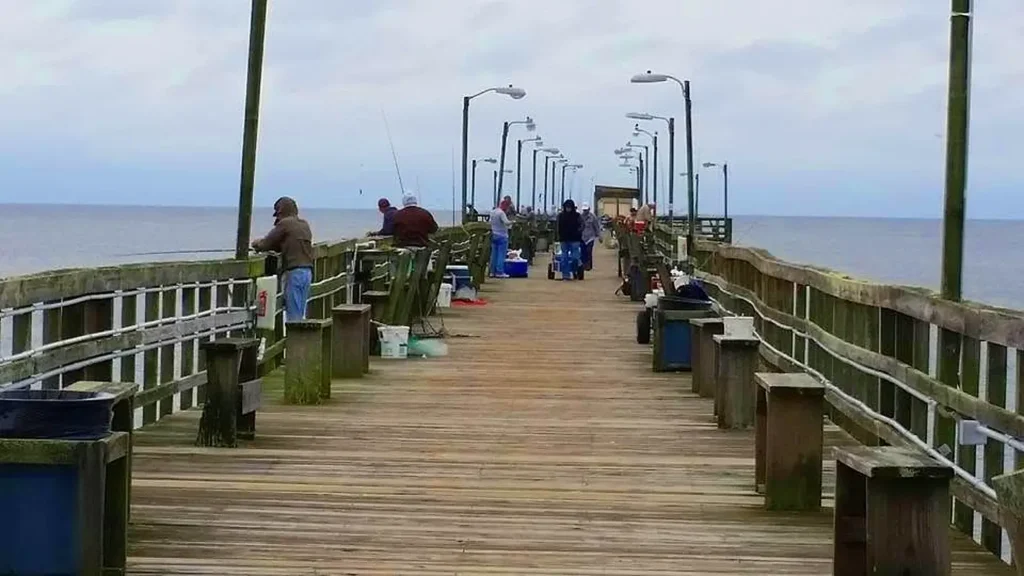
Fishing from a licensed public pier in either state generally exempts you from needing a personal fishing license. In South Carolina, piers in Myrtle Beach and Folly Beach have on-site tackle shops with up-to-the-minute reports on what’s biting and where.
What Is the Best Bait for Saltwater Fishing the Carolina Coast?
Ask ten Carolina anglers this question and you’ll get ten passionate, contradictory answers. That’s part of the culture. But certain baits have earned near-universal trust along this coastline.
The universal truth: fresh beats frozen, and local beats imported. Every good bait shop from Corolla to Hilton Head stocks what’s working that day. Stop in, spend ten dollars, and listen.
Red Drum / Redfish:
Live finger mullet, fresh shrimp, menhaden (pogies), mud minnows, and blue crabs. Cut spot heads work exceptionally well for big fall drum on the Outer Banks.
Flounder:
Live mud minnows (mummichogs) are the gold standard. Squid strips and live shrimp on a Carolina rig also produce. Work the bait slowly, flounder are ambush predators, not chasers.
Pompano:
Sand fleas (mole crabs) are the top choice, you can rake them right from the surf zone. Small shrimp and fresh sand flea-scented lures also work well on a light bottom rig.
Spanish Mackerel:
Go artificial: silver spoons, small Clark spoons, and fast-moving jigs. Mackerel are visual, speed-oriented predators. Cast ahead of a breaking school and retrieve fast.
Speckled Trout:
Live shrimp under a popping cork is the classic presentation. Soft plastic paddle tails in chartreuse or white on a light jig head work equally well in the sound and creek systems.
Sheepshead:
Fiddler crabs and sand fleas are essential. Sheepshead have hard mouths and steal bait expertly; use a small, sharp hook and keep your line taut near structure like pier pilings.
For general surf fishing, when you don’t know exactly what’s out there, shrimp is your safety net. Virtually every saltwater species along the Carolina coast will eat a piece of fresh shrimp. Squid strips are a close second, especially for bottom-feeding species like sea bass and black drum.
Local’s Take:
Here’s what most visiting anglers miss: bloodworms and sand fleas can be collected right from the beach for free. Sand fleas bury themselves in the wet sand at the wave’s edge. A sand flea rake costs about $15 and can produce more bait in 20 minutes than a tackle shop sells in a morning.
Do I Need a License to Fish in the Ocean?
Yes in both states. But the process is genuinely painless, and the cost is modest.
North Carolina
Anyone age 16 or older fishing in North Carolina’s coastal waters needs a Coastal Recreational Fishing License (CRFL), administered by the NC Division of Marine Fisheries. This covers the ocean, sounds, coastal rivers, and their tributaries out to three miles offshore. You can buy one for 10 days, annually, or for a lifetime, and every bait shop on Hatteras Island sells them over the counter. A 10-day license for out-of-state visitors runs around $10. Annual licenses are available in the $15–$30 range depending on residency and coverage. Notably, North Carolina began requiring mandatory harvest reporting in December 2025 for red drum, flounder, striped bass, spotted seatrout, and weakfish, keep that in mind when you land one of those species.
The one major exception: if you’re fishing from a licensed public fishing pier or aboard a licensed charter vessel while under hire, you’re covered by the vessel or pier’s blanket license. No personal license needed.
South Carolina
South Carolina requires a Saltwater Recreational Fishing License for anyone 16 and older fishing from shore, a boat, a private dock, or while wading. That includes the beach. The SC license runs $15 annually for residents or $75 for nonresidents on an annual basis; a 14-day temporary license is available for $10. The same pier exemption applies: fishing from a licensed commercial public fishing pier in South Carolina does not require a personal license. The pier fee covers it.
Insider Tip:
Both states allow you to purchase licenses online before your trip. Don’t wait until you’re already on the beach as most beachside bait shops open early but can get crowded on summer mornings. Grab your license from the NC or SC wildlife agency websites the night before.
Do Fish Bite Better in the Morning or Afternoon at the Coast?
This is the question every angler asks, and the honest answer is nuanced but there is a clear lean. Low-light periods consistently outperform the full glare of midday. That means early morning and late afternoon/evening are your best windows, generally speaking.
The biology is straightforward. Baitfish and prey species are more active near the surface in low light. Predator fish, the ones you’re chasing, know this and time their feeding accordingly. Add in the fact that surface water temperatures are lowest in the morning after overnight cooling, which keeps dissolved oxygen levels higher and fish more energetic, and the dawn window earns its reputation.
However, on the Carolina coast, tides matter just as much as the clock and arguably more. A moving tide, whether incoming or outgoing, pushes bait and triggers feeding behavior far more reliably than simply showing up at dawn. Slack tide, when water barely moves, tends to shut fish down regardless of the hour. A fast-moving incoming tide at 2 p.m. will frequently outfish a flat, slack dawn session.
Additionally, season shifts the calculus significantly. In summer, midday heat drives fish deep or into cooler tidal creeks, morning fishing becomes dramatically more productive. In winter, the opposite often holds: water temperatures rise slightly through the afternoon, and that’s when fish become more active and willing to eat.
Finally, for surf fishing specifically, overcast days extend the productive window considerably. Cloud cover reduces light penetration, keeps water temperatures more stable, and makes fish less wary. A cloudy afternoon in October with an incoming tide on Hatteras Island? That’s not a bad day. That’s a great one.
Local’s Take:
Local guides on the Outer Banks often say: “Fish the tide, not the clock.” Two hours before and two hours after high tide, especially on a new or full moon, is where they put their money. The dawn bias is real, but a strong tidal movement at noon beats a slack sunrise every time.
The Neuse and Pamlico rivers are some of the most underrated fishing waters in the Carolinas, and the towns around them make a perfect base camp. Our Inner Banks guide covers Oriental, Bayboro, and Vandemere, where the docks are working and the seafood never has a long commute.
Frequently Asked Questions
Can I surf fish at any beach along the Carolina coast?
Generally, yes, most ocean-facing beaches in North and South Carolina allow surf fishing. However, some areas within Cape Hatteras National Seashore require an Off-Road Vehicle (ORV) permit to access remote sections by truck. A few local ordinances also restrict fishing near designated swimming areas during summer peak hours. Always check local beach rules before setting up.
What is the best time of year to fish the Carolina coast?
Fall, September through November, is widely considered the prime season, especially in North Carolina. This is when large red drum schools move through the Outer Banks and water temperatures drop into the ideal range. Spring is excellent for cobia, Spanish mackerel, and flounder. Summer brings Spanish mackerel, king mackerel, and pompano in SC. Winter is slower but not dead, sheepshead and black drum feed year round near structure.
What species can I realistically catch from the beach in the Carolinas?
A strong list: red drum, black drum, flounder, pompano, bluefish, Spanish mackerel, speckled sea trout, sheepshead, whiting (sea mullet), croaker, spot, and various species of shark. With the right bait and timing, cobia and king mackerel are also catchable from shore at productive points. Species availability varies significantly by season and location along the coast.
Is a fishing guide or charter necessary to have a good experience?
Not at all, and that’s one of the great things about the Carolina coast. Surf fishing and pier fishing are genuinely accessible to beginners. That said, hiring a local inshore guide for a half-day trip (especially in the Lowcountry or Beaufort area) dramatically accelerates your knowledge. Guides know the tides, the grass flats, and the fish’s seasonal movements in ways that take years to learn independently. If you’re serious about targeting a specific species like redfish or cobia, a guide is money well spent.
What gear do I need for surf fishing the Carolina coast?
A medium-heavy spinning rod in the 10–12 foot range pairs well with a 4000–6000 series reel spooled with 15–20 lb monofilament or 20–30 lb braid. A pyramid sinker (3–5 oz, heavier in rough surf) keeps your bait anchored. Bring a sand spike to hold your rod, a cooler with ice, and a license. Local bait shops can set you up with terminal tackle specific to whatever’s running that week.
For more Carolina coastal travel inspiration and guides, keep exploring explorecarolinabeaches.com
Planning a Carolina beach trip? Use our Beach Finder Quiz to get a personalized recommendation, or compare any two beaches side by side with the Carolina Beach Comparison Tool.
📱 Download our free Carolina Beaches app — Get it here