
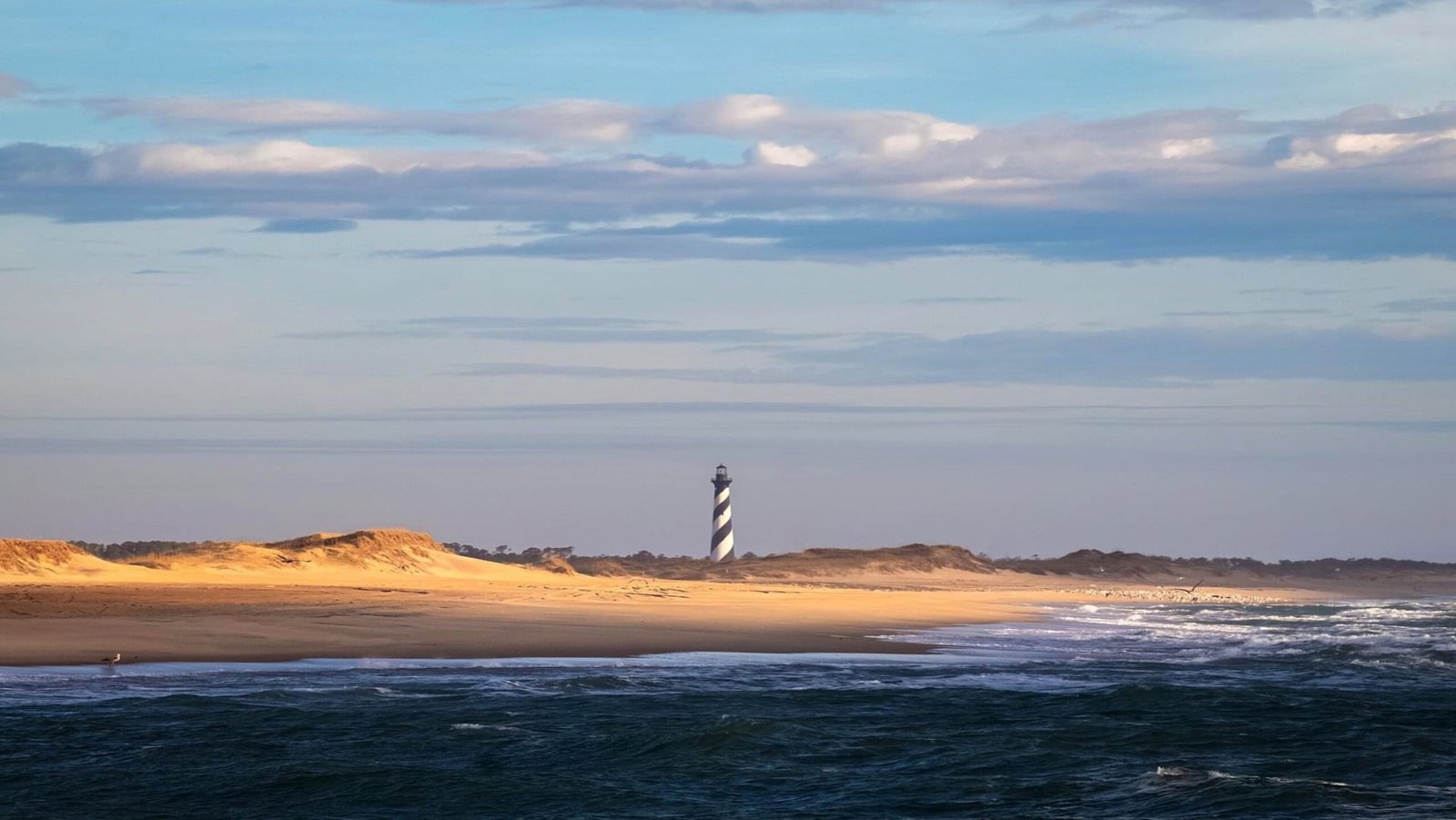
There is a point on the drive south through Hatteras Island when the Outer Banks stops being a beach vacation and starts being something else entirely. Somewhere around the village of Buxton, you catch your first glimpse of it: a towering black-and-white candy cane stripe reaching up above the horizon, visible long before you can see its base.
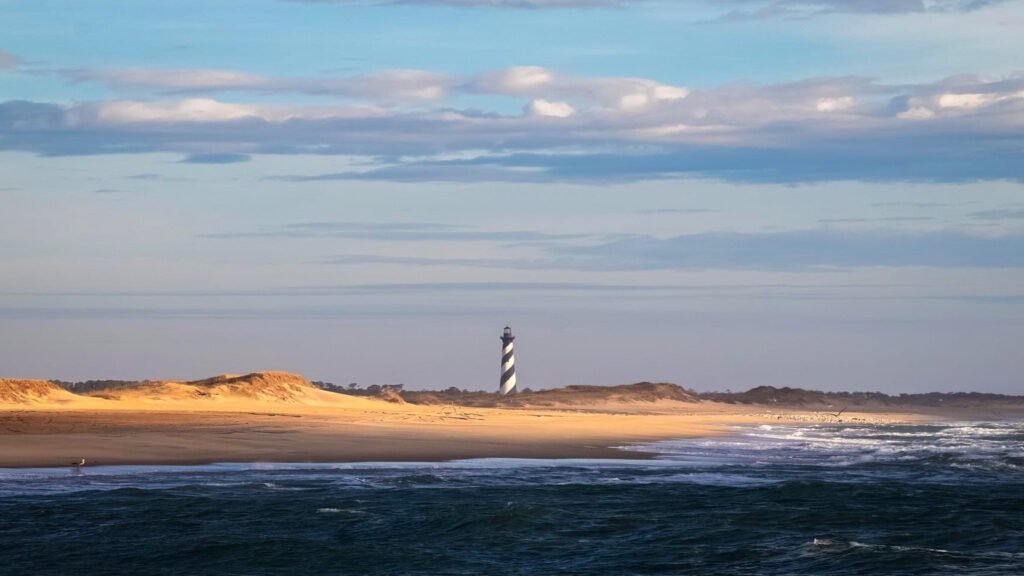
The Cape Hatteras Lighthouse. The tallest brick lighthouse in the United States. The icon of the entire Outer Banks.
Cape Hatteras is not for everyone, and it knows it. This is the southern end of Hatteras Island, a stretch of barrier island so far from the mainland that getting here requires serious commitment, and so firmly inside the Cape Hatteras National Seashore that development is minimal by law. What it offers in exchange for that effort is extraordinary: some of the most productive fishing waters on the Atlantic coast, miles of protected, uncrowded beach, a lighthouse with one of the most dramatic histories in America, and a ferry ride to Ocracoke Island that is, independently, one of the best things you can do on the entire OBX.
Here’s how to make the most of it.
The Lighthouse: The Tallest, the Most Moved, and the Most Worth It
Let’s start with the icon, because it genuinely earns the superlatives thrown at it.
The Cape Hatteras Lighthouse stands 198 feet tall, the tallest brick lighthouse in the United States, and its distinctive diagonal black and white spiral stripes make it one of the most recognized lighthouse silhouettes in the world. The stripes weren’t purely decorative: they were applied in 1873 as a deliberate daymark, so sailors could identify this specific lighthouse from others along the coast during daylight hours. Its first-order Fresnel lens flashes a white light every 7.5 seconds, visible for up to 20 nautical miles offshore.
The lighthouse you see today is the second built on this site. The first, completed in 1803, stood just 90 feet tall and was widely considered inadequate; captains complained constantly that its light was insufficient in fog and haze. A replacement was finally authorized and the current structure was first lit on December 16, 1870, at a cost of $167,000. When it was completed, it was the tallest brick lighthouse tower in the world.
Then came the water. When the lighthouse was built in 1870, it stood roughly 1,500 feet from the ocean. By the 1990s, erosion had brought the surf to within 50 to 70 feet of its base. The decision was made after significant debate to move the entire structure. In 1999, in what engineers called the “Move of the Millennium,” the 4,800-ton lighthouse was lifted and transported 2,900 feet to the southwest along a system of steel track beams and hydraulic jacks. The entire operation took 23 days. It remains one of the tallest masonry structures ever relocated in history.
Today the lighthouse sits safely 1,500 feet from the current shoreline, right where it started 150 years ago. You can climb it all 257 steps from the third Friday in April through Columbus Day. Climbs run daily from 9 AM to 4:30 PM. Tickets are $8 for adults, $4 for children (at least 42 inches tall), and seniors. No advance sale as tickets are purchased in person the day of your climb. The view from the top is a full 360 degrees: Hatteras Island stretching away in both directions, the Atlantic on one side, the Pamlico Sound on the other, the Diamond Shoals just offshore where hundreds of ships met their end.
Plan a full morning here. The visitor center, the historic keeper’s quarters (also relocated in 1999), and the grounds are all worth your time.
The Fishing: This Is the Real Deal
Cape Hatteras is not casually a fishing destination. It is specifically, deliberately, obsessively a fishing destination, and for very good reason.
Just offshore lies Diamond Shoals, a cluster of shifting underwater sandbars where the warm Gulf Stream current collides with the cold Labrador Current. This collision creates a nutrient-rich mixing zone that draws extraordinary concentrations of fish: bluefin tuna, yellowfin tuna, mahi-mahi, wahoo, billfish, Spanish mackerel, red drum, flounder, and more. The area earned the nickname “Graveyard of the Atlantic” for the ships that wrecked on those shoals, but for anglers, the same geography is paradise.
Surf fishing from the Cape Hatteras National Seashore beaches is legendary, particularly in fall and spring when red drum run along the coast. Inshore fishing on the Pamlico Sound produces excellent flounder and sea trout. And offshore, charter boats running out of Hatteras Village put anglers within a short run of the Gulf Stream, one of the closest access points to deep-water sport fishing on the entire East Coast.
Hatteras Village’s marina is a serious operation: a concentration of charter captains running everything from half-day nearshore trips to full-day Gulf Stream adventures. If offshore fishing is a priority, book your charter boat before you book your rental house. The best captains fill their calendars months in advance in summer.
A note: a valid North Carolina saltwater fishing license is required for surf fishing. Check current beach driving and access regulations with the National Park Service before heading to the 4WD ramps, seasonal closures for shorebird nesting can affect access in summer.
The Ferry to Ocracoke: Don’t Skip This
Here is something I want to say directly: if you are staying anywhere near Cape Hatteras and you do not take the ferry to Ocracoke, you are leaving one of the genuinely great experiences of the entire Outer Banks on the table.
The Hatteras-Ocracoke ferry departs from the Hatteras ferry terminal (right off NC-12 in Hatteras Village) and runs 365 days a year, from 5 AM to midnight. It is completely free. The crossing takes about one hour and ten minutes each way, and it is a beautiful ride, open water in every direction, pelicans gliding alongside the boat, Pamlico Sound spreading flat to the horizon.
On the other end is Ocracoke Island, one of the most singular places in North Carolina. The village covers about four square miles, has roughly 1,000 year-round residents, and feels like the Outer Banks as it was before the world found it. The Ocracoke Lighthouse, built in 1823, is the second-oldest operating lighthouse in the United States and North Carolina’s oldest; at 75 feet tall, it’s also the smallest on the OBX, and it’s not open for climbing, but the grounds are lovely and the setting is pure Outer Banks charm. Blackbeard the pirate made Ocracoke his home base, and met his end in Ocracoke Inlet on November 22, 1718. The village has great seafood restaurants, locally owned shops, a small but excellent beach, and a pace that immediately makes you want to slow down.
Practical ferry notes: The Hatteras-Ocracoke car ferry cannot be reserved, it’s first come, first serve, so arrive early, especially in summer. The busiest days for day-trippers are typically Tuesday through Thursday. The last ferry from both sides runs at midnight; don’t miss it. During peak season (generally July 3 through September 10), there’s also a paid passenger-only ferry running $5 one way, useful if you want to leave your car at Hatteras and just walk around Ocracoke. Once on the island, bikes and golf carts are rentable near the ferry terminal, and free tram service operates around Ocracoke Village.
The Beach: Uncrowded, Wild, and Extraordinary
The Cape Hatteras National Seashore manages the beaches around Cape Hatteras village and Buxton, and what that means in practice is: wide, clean, relatively empty shoreline with no commercial development in sight. The national seashore stretches for 70 miles along the barrier islands, and the beaches here are some of the most unspoiled on the East Coast.
Lifeguard stands operate at designated areas Memorial Day through Labor Day. Rip currents are a real and consistent hazard throughout Hatteras Island. The surf on the Cape Hatteras beaches can be powerful and is generally not recommended for young children or inexperienced swimmers except on calmer days.
For 4WD beach enthusiasts, multiple off-road vehicle ramps are accessible throughout the Cape Hatteras National Seashore. A free beach driving permit is required from the NPS; some ramps may have seasonal closures for bird and sea turtle nesting, so check current conditions at the visitor center before heading out.
Staying at Cape Hatteras: What the Rental Market Looks Like
Cape Hatteras and the surrounding villages of Buxton, Frisco, and Hatteras Village are primarily a vacation rental market, and the inventory here has a character that’s distinctly different from the northern OBX towns. These are quieter, more remote communities with a genuine working-waterfront feel. The rental homes tend toward spacious beach houses with excellent access to the beach and the national seashore.
Large rental management companies like Midgett Realty, Surf or Sound Realty, and Hatteras Realty handle most of the inventory and collectively offer hundreds of properties across the southern island communities. Properties range from modest cottages to large oceanfront homes with private pools. Because Hatteras Island is so popular with fishing families and serious beach travelers, amenities like fish-cleaning stations, boat parking, and outdoor showers are common.
Book early. Summer weeks fill up months in advance. Shoulder season (April-May, September-October) is genuinely exceptional here: the fishing is often at its best in fall, the beaches are even emptier, the ferry line for Ocracoke is shorter, and the lighthouse is still open for climbing. October is one of the best months to be on Hatteras Island, full stop.
The NPS also operates Cape Point Campground and Frisco Campground within the national seashore, both open seasonally. For tent campers and RV travelers, these are among the most dramatic camping locations on the East Coast, right in the dunes, with the Atlantic steps away. Be careful where you pitch a tent, though. It’s not legal everywhere to sleep on the beach.
For groceries and supplies, Conner’s Supermarket in Buxton and Village Red & White in Hatteras Village are the main options. Stock your kitchen before you arrive; the nearest large grocery stores are well north of the island. Local seafood markets including Harbor House Seafood Market, Buxton Seafood, and Surf’s Up Seafood Market, carry the freshest local catch and are excellent for fish-house style cooking in your rental.
Where to Eat: Real Seafood, Real Atmosphere
Hatteras Island’s restaurant scene is built around local seafood and unpretentious hospitality. A few places worth knowing:
Hatteras Sol Waterside Grill sits on the southern edge of Hatteras Village, surrounded by water on multiple sides, with spectacular Pamlico Sound views and classic Hatteras dishes, including fresh crab cakes and local seafood. It’s popular and worth it.
Café Pamlico at the Inn on Pamlico Sound is the island’s most upscale dining experience: an intimate restaurant with Sound views and a farm-to-table approach, using produce grown in their own on-site garden. Chef-driven, reservation-recommended, genuinely special for a date night or a celebration dinner.
Dinky’s Waterfront Restaurant in Hatteras Village is a long-standing local favorite known for fresh seafood and a waterfront atmosphere that delivers exactly what you want at the end of a beach day. Busy on weekends so arrive early or plan to wait happily with a drink.
Sonny’s Restaurant is a family-owned Hatteras Village institution, open for breakfast, lunch, and dinner, with the kind of from-scratch consistency that keeps people coming back year after year for forty-plus years.
Hatteras Village Fish Fry is not a restaurant in the traditional sense: it’s a fish fry, which means you wait in line, you get spectacular fried seafood fresh from local waters, and you eat it happily. The line can run over an hour in summer. Locals will tell you it’s worth it.
Dancing Turtle Coffee Shop handles the essential morning coffee situation with espresso drinks, seasonal specials, and smoothies, important logistics for early-morning fishing departures and sunrise beach walks.
One practical note: most restaurants on Hatteras Island close by 9 PM. Plan your dinner timing accordingly, especially if you’re arriving back from a late charter or an Ocracoke day trip.
The Honest Bottom Line
Cape Hatteras is the Outer Banks for people who want the real thing. Not the t-shirt shops and the putt-putt golf and the chain restaurants but the actual thing: a wild, wind-scoured barrier island with a lighthouse that has been warning ships away from a graveyard of shoals for over 150 years, fishing that draws people from across the country, beaches so open and empty that you can walk for an hour and feel genuinely alone on the coast, and a ferry that takes you somewhere even more beautiful.
It asks something of you: the drive is long, the logistics require planning, the remoteness is real. But that’s also exactly why it’s worth it.
Come for the lighthouse. Stay for the fishing. Take the ferry. You’ll be back.
For more Carolina vacation area guides and Carolina coastal travel inspiration, keep exploring explorecarolinabeaches.com
FAQ
Is Cape Hatteras good for families with young children?
Yes. Cape Hatteras offers wide beaches, natural beauty, wildlife viewing, and a slower pace than many resort destinations. Families who enjoy nature, fishing, shelling, and uncrowded beaches often consider it one of the best areas in the Outer Banks.
When is the best time to visit Cape Hatteras?
May through June and September through October offer warm weather, comfortable water temperatures, and fewer crowds. Summer is popular for beach vacations, fishing, and watersports.
Are dogs allowed on Cape Hatteras beaches?
Yes. Dogs are generally allowed on many beaches within Cape Hatteras National Seashore, though leash requirements and protected wildlife areas may restrict access in certain locations.
Is parking free at Cape Hatteras?
Yes. Most beach access areas within the national seashore provide free parking, making it easy to explore different stretches of coastline.
How far is Cape Hatteras from Charlotte, Raleigh, Cleveland, and Nashville?
Charlotte: about 430 miles (7–8 hours)
Raleigh: about 260 miles (4.5–5 hours)
Cleveland, Ohio: about 700 miles (11–12 hours)
Nashville, Tennessee: about 810 miles (12–13 hours)
What is Cape Hatteras known for?
Cape Hatteras is famous for its wild, undeveloped beaches, world-class fishing, surfing, kiteboarding, shipwreck history, and the iconic Cape Hatteras Lighthouse, the tallest brick lighthouse in the United States.
What are the best restaurants near Cape Hatteras?
Popular local favorites include Orange Blossom Bakery & Cafe for breakfast, Diamond Shoals Restaurant for seafood and local favorites, Café Pamlico for waterfront dining, and Dinky’s Waterfront Restaurant for fresh seafood and harbor views.
Planning a Carolina beach trip? Use our Beach Finder Quiz to get a personalized recommendation, or compare any two beaches side by side with the Carolina Beach Comparison Tool.